
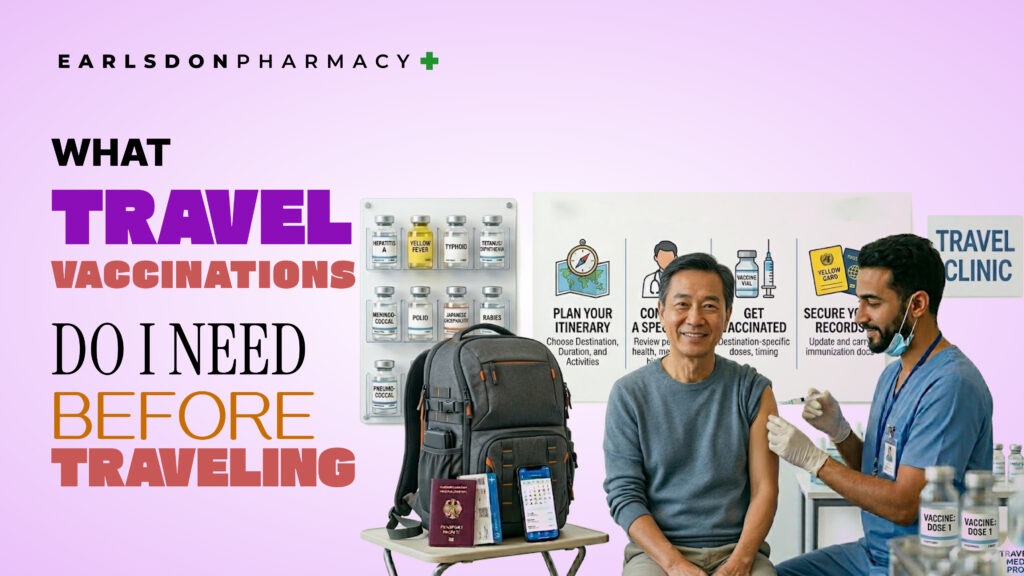
What Travel Vaccinations Do I Need Before Travelling?
Planning a trip abroad is exciting. But before you pack your bags, there is one thing you must not forget your travel vaccinations. Many people leave this until the last minute or skip it altogether. That is a mistake that can cost you your health. Getting vaccinated before you travel protects you from diseases that are common in other parts of the world. Your body has never been exposed to many of these diseases, so it has no natural defence against them. A travel vaccine teaches your immune system how to fight a specific disease before you ever come into contact with it.
This guide covers everything you need to know about travel vaccinations which ones you need, when to get them, and where to go.
Why Are Travel Vaccinations Important?
When you travel to certain parts of the world, you are exposed to diseases that simply do not exist in the UK. Things like Yellow Fever, Typhoid, and Japanese Encephalitis are rare here but common elsewhere.
You do not have to do anything risky to catch them. Eating local food, drinking water, or even walking through a busy market can be enough. Some of these diseases are mild. Others can be life-threatening.
The good news is that most travel-related diseases are completely preventable. Getting the right vaccinations before you go is the simplest and most effective thing you can do to protect yourself.
How Far in Advance Should You Get Vaccinated?
You should book your travel vaccinations at least six to eight weeks before your departure date. This gives your body enough time to build proper immunity before you travel.
Some vaccines require more than one dose spread over several weeks. The Rabies vaccine, for example, needs three doses over 21 days. If you leave it too late, you may not be able to complete the full course before you fly.
Booking early also gives your pharmacist or GP time to carry out a proper health assessment and make sure you get everything you need.
What If You Are Travelling Last Minute?
If your trip is just around the corner, do not panic. Getting even one dose of a vaccine is better than getting none at all. A single dose of Hepatitis A, for example, still offers good protection.
Visit your local pharmacy as soon as possible. Pharmacies can often see you quickly without the long waiting times of a GP surgery. A last-minute jab is always better than travelling with no protection at all.
Which Vaccines Do You Need Based on Your Destination?
There is no one-size-fits-all answer. The vaccines you need depend on where you are going, how long you are staying, and what you will be doing there. Below is a general guide by region.
Africa
If you are travelling to sub-Saharan Africa, you will most likely need Yellow Fever, Typhoid, and Hepatitis A. Many African countries require proof of Yellow Fever vaccination before they will allow you to enter. Rabies and Meningitis ACWY may also be recommended depending on your specific destination.
Asia and Southeast Asia
For travel to South or Southeast Asia, Typhoid, Hepatitis A, and Japanese Encephalitis are commonly recommended. If you are travelling to rural areas or staying for more than four weeks, the risk of Japanese Encephalitis is higher. Hepatitis B and Rabies may also be advised.
South America
Yellow Fever is the main concern for travel to tropical areas of South America. Typhoid and Hepatitis A are also commonly recommended. Check your specific destination carefully as requirements vary by country and even by region within a country.
Middle East Hajj and Umrah
If you are travelling to Saudi Arabia for Hajj or Umrah, the Meningitis ACWY vaccine is not just recommended it is mandatory. You will not be able to obtain your visa without proof of this vaccination. Speak to your pharmacist well in advance to make sure you have the right documentation.
Complete List of Travel Vaccines
The vaccines below are the most commonly needed for international travel. Not all of them will apply to your trip. Your pharmacist will advise you based on your destination and health history.
Hepatitis A protects against a liver infection spread through contaminated food and water. It is one of the most commonly recommended travel vaccines regardless of destination.
Hepatitis B protects against a liver infection spread through blood and bodily fluids. It is recommended for longer trips or if you may need medical treatment abroad.
Typhoid protects against a bacterial infection spread through contaminated food and water. It is recommended for travel to Asia, Africa, and South America.
Yellow Fever protects against a mosquito-borne virus. It is required for entry into several countries in Africa and South America.
Rabies protects against a fatal virus spread through animal bites. It is recommended if you will be in rural areas or working with animals.
Japanese Encephalitis protects against a mosquito-borne infection affecting the brain. It is recommended for travel to rural parts of Asia.
Meningitis ACWY protects against bacterial meningitis. It is mandatory for Hajj and Umrah pilgrims and recommended for travel to the meningitis belt of sub-Saharan Africa.
Cholera protects against a severe waterborne illness. It is recommended for travellers with underlying health conditions or those visiting high-risk areas.
Tick-Borne Encephalitis protects against a virus spread by tick bites. It is recommended for travel to forested areas of Central and Eastern Europe.
Required vs Recommended What Is the Difference?
A required vaccine is one you must have to enter a country. Without it, you may be refused entry at the border. A recommended vaccine is not legally required but is strongly advised to protect your health.
Skipping a recommended vaccine does not mean you will be turned away at the border. But it does mean you are travelling without protection against a disease that could seriously harm you.
What Is the Yellow Card (ICVP)?
The Yellow Card is the informal name for the International Certificate of Vaccination or Prophylaxis. It is an official document that proves you have received certain vaccines, most commonly Yellow Fever.
Many countries in Africa and South America will ask for your Yellow Card at the border. Without it, you may be refused entry or vaccinated on the spot under conditions that may not be ideal. You receive your Yellow Card from an authorised vaccination centre at the time of your jab.
How Much Do Travel Vaccines Cost in the UK?
The cost of travel vaccines in the UK depends on whether they are available on the NHS or must be paid for privately.
Free NHS Vaccines vs Paid Private Vaccines
Some travel vaccines are available free on the NHS. These include Hepatitis A, Typhoid, Polio, and Cholera. To access these, you need to visit a GP surgery that provides NHS vaccination services.
However, several important travel vaccines are not available on the NHS and must be paid for privately. These include Yellow Fever, Hepatitis B, Japanese Encephalitis, Meningitis ACWY, Rabies, and Tick-Borne Encephalitis.
The smartest approach is to get your free NHS vaccines through your GP and your paid vaccines through your local pharmacy. This way you cover everything without paying more than you need to.
Travel Vaccinations for Special Circumstances
Some people need extra care and advice when it comes to travel vaccinations. If any of the following apply to you, speak to your pharmacist or GP before booking your jabs.
Pregnancy and Weakened Immune System
If you are pregnant, some vaccines are not suitable. Live vaccines like Yellow Fever are generally avoided during pregnancy because they contain a weakened form of the virus. Your pharmacist or GP will advise which vaccines are safe for you.
If you have a condition that affects your immune system, or if you are undergoing chemotherapy, some vaccines may not work as effectively or may not be recommended at all. Always get personalised advice before travelling.
Children
Children can receive most travel vaccines, but the timing and dosage are often different from adults. Some vaccines are only suitable from a certain age. Plan well in advance and speak to a pharmacist or GP to make sure your child is fully protected before you travel.
Where Can You Get Travel Vaccinations in the UK?
There are three main options for getting travel vaccinations in the UK your GP surgery, a private travel clinic, or your local pharmacy.
Your GP can provide some vaccines free on the NHS. However, GP surgeries often have long waiting times and may not stock the full range of travel vaccines you need.
Private travel clinics have specialist expertise but tend to be the most expensive option. You will often pay a consultation fee on top of the vaccine cost.
For most people, a local pharmacy is the most convenient and affordable choice. You do not need a referral. Waiting times are short. Pharmacists are fully trained to give travel vaccines and provide personalised advice based on your destination and health history.
What Are the Side Effects of Travel Vaccines?
Travel vaccines are very safe. Most people experience little or no side effects at all.
The most common side effects are mild soreness, redness, or swelling at the injection site. You may also feel tired or have a slight fever for a day or two after your jab. These are normal signs that your immune system is responding to the vaccine.
Serious side effects are very rare. Your pharmacist will talk you through what to expect after each vaccine and answer any questions you have. If you feel unwell after a vaccination and you are concerned, speak to your pharmacist or call NHS 111.
Get Your Travel Vaccinations at Earlsdon Pharmacy Coventry
If you are based in Coventry and need travel vaccinations, Earlsdon Pharmacy offers a full travel clinic service. The team is trained in travel health and can advise you on exactly which vaccines you need based on your destination.
Vaccines available include Hepatitis A, Hepatitis B, Typhoid, Yellow Fever, Rabies, Japanese Encephalitis, Meningitis ACWY, Cholera, Tick-Borne Encephalitis.
Booking is simple and can be done online. Try to book at least six to eight weeks before you travel. You can visit the pharmacy at 19-21 Earlsdon Street, Coventry, CV5 6EP or call 02476714834.
